
"Interview with John Rosewarn for Queer in Brighton Oral History Project (28 May 2013), interviewed by ??.
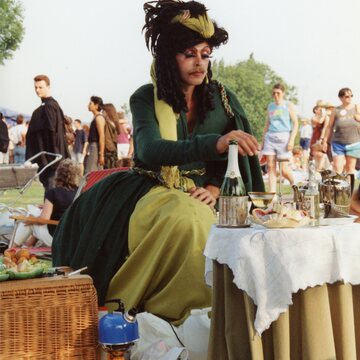
Oral history interview collected as part of the Queer in Brighton project 2013-2014. Life history from Taunton to Brighton DOB 1944 circa - leaves home at 18 (gets thrown out by father after being caught in bed with dad’s best mate) goes to London -sex worker from 18 to 24 years of age 1961 to 1967 - moves to Brighton 1969. Trains as a nurse - lives in Brighton- work students in Hayward’s Heath. Moves to Spain from 1991-1999. Talks about sex work, cottaging and it’s demise in the early 1980s, celebrities, work as a nurse, homophobia, bars in Brighton, his relationship with older man - open relationship- promiscuity, first Pride, estrangement from parents, drag persona. "
Roni is interviewed by Ten Harber. Roni moved to Brighton in 2009 from Rome after previously visiting Brighton Pride. She speaks about the origin of Tramfrau as a response to Brighton’s nightlife being primarily geared towards students. She talks about how an activity space was included in the event to encourage interaction and socialising beyond the dancefloor. She talks about the risks taken to include different types of performance and music and how that has been unappreciated or misunderstood. Feedback is an important part of the process and has shaped how this event has changed over time.
As the night became more successful it moved to a larger venue and some measures were taken to counteract antisocial behaviour, such as through the marketing of the event as well as featuring politics as part of the decor. She speaks further about the sensitivities around the language used to describe and conceptualise the night and how this has evolved alongside the event itself.
Rory Smith is interviewed by David Sheppeard in The Marlborough theatre green room. Rory came to Brighton in 2001 when he was 18 for university. He speaks about other close family members coming out to him before he came out as bisexual, and how it wasn’t until his third year of university that he discovered LGBT nightlife in Brighton. He speaks about being intimidated by the lesbian scene in the mid-2000s and how starting a drag king troupe helped him explore his gender identity. Whilst working for a trans charity he began to be solely referred to as Rory and use he/him pronouns. He speaks about bi erasure in Brighton and how it has been even more of a challenge post-transition
Rory talks about being part of the group that started the Club Wotever events at The West Hill, which was one of the only alternative queer events at the time. The Cowley Club is also mentioned as part of this scene and it’s involvement with Queer Mutiny, an activist group. Rory then became involved in FTM Brighton and notes how a Trans Day of Remembrance became the catalyst for a new wave of local trans activism, including Trans Pride.
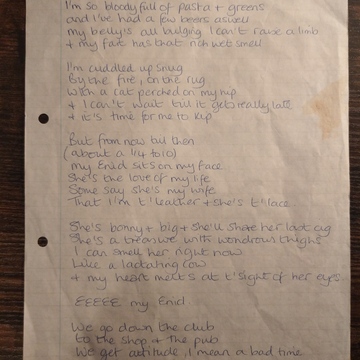
Latex Theatre was initiated as part of a sexual health project, in Leeds, in the early 90s. The group met weekly in the AIDS Advice Centre, and wrote collectively and individually.
1. A manuscript of a poem that Janet co-wrote in 1994 with her partner. The poem was read and performed on tour across the country.
2. A photograph of Janet and another member of Latex theatre performing a short piece at London Pride between 1993 and 1995.
The piece was short and punchy and delivered in an angry tone. Each of the sentences was made from tabloid newspaper headlines, and the homophobic language used around HIV/AIDS.
"AIDS, you're better off dead.
AIDS, a bullet in the head.
AIDS, you made your bed, lay on it"
3. Stupid Bastard: a sketch written by Janet Jones for Latex Theatre in 1993. The piece is a commentary on current legislation on AIDS, rape, MSM, the prison population, the age of consent, and drug use.
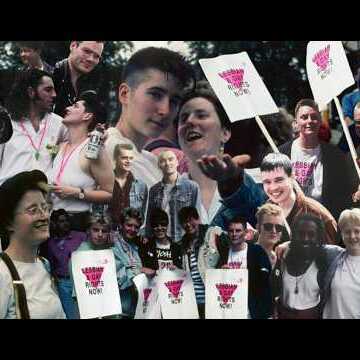
Abigail Dombey in conversation with Kate Wildblood, reflecting on queer life on Brighton during 1989-1992 and the community created through protest and Pride courtesy of the discovery of Abigail’s long lost slide film collection.
From her job in the local camera shop to the streets of Brighton, Abigail Dombey, a budding 18-year-old queer reportage photographer, was capturing the passion and the prejudice of early 1990s Brighton, one 35mm slide film at a time.
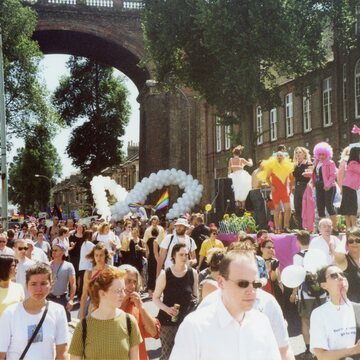
A time where bigotry and fear stalked the LGBTQ+ community as they fought against the Tories’ hateful Section 28 legislation, the media’s toxic narrative and society’s demonisation of queer lives at a time of the HIV and AIDS pandemic. A time of Doc Marten’s pounding the streets in protest, placards held high, hearts full of the desire for action (and occasionally each other). A time of grassroots activism as the shame fuelled by Section 28 loomed large over our lives, homophobic violence a daily reality, challenging our sense of LGBTQ+ community as we fought to create our modern day Pride movement.
It was our time, of baby dykes and glorious queers, of prejudice, protests and those all-important picnics. A time that saw us determined to challenge the unremitting homophobia that filled our lives and change the world together. One protest t-shirt at a time.
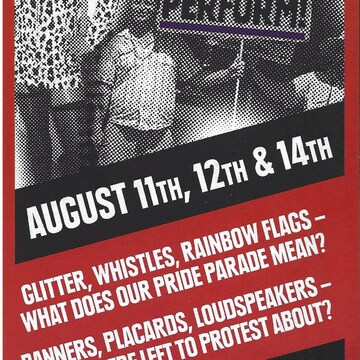
History isn't just in the past; it's in the present. All the steps and moments we take as a community lead to radical changes. We invite you to bring photos or look through your memories of what's in Brighton and is making history. We will have a map of Brighton to gather around and discuss what makes Brighton the place for you.
Queer Heritage South; powered by Marlborough Productions. Made possible thanks to The National Lottery Heritage Fund.
Filmed by Lucy Lebrocq
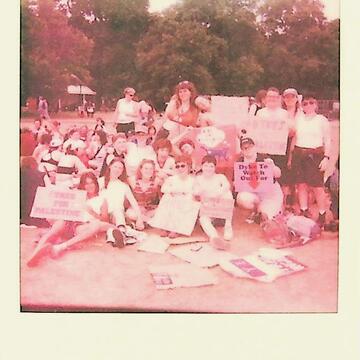
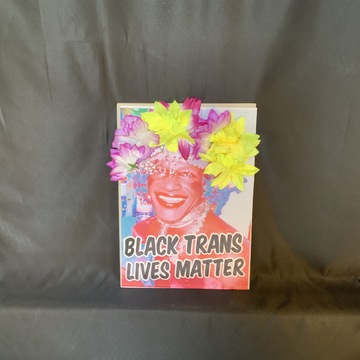
Saturday 21st June - Brighton dykes congregate in joy and power post-march in the sun. A selection of hand made protest signs are held in pride and solidarity with trans friends and Palestine.
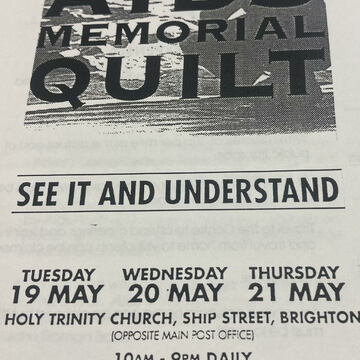
National AIDS Memorial Quilt
On the 14 March 1992, Our House Body Positive & Pink Parasol held their first support group to encourage Brighton contributions to the National AIDS Memorial quilt at the Morley Street Family Centre. At this first session the film ‘Common Threads – Stories from the Quilt’ was shown, and this inspired me to create a quilt panel for my friend Andrea Philippe Regard.
A series of exhibitions of the completed 6’ x 3’ panels celebrating the lives of people who died was arranged as part of the 1992 Brighton Lesbian and Gay Pride. On the 17th May (then known as Lesbian & Gay Remembrance Day - now International Day Against Homophobia, Biphobia and Transphobia) some of the quilt panels were displayed in the Brighton Museum, and then between the 19th and 21st May the whole National AIDS Memorial Quilt was laid out at the Holy Trinity Church, Ship Street - now the home of the Fabrica Gallery.
The quilt which my ex-partner Alf Le Flohic and his friend John Twoomey helped me to make, was also displayed at the Brighton Gay and Lesbian Pride celebration in Preston Park that year.
Philip’s panel was part of the AIDS Memorial Quilt display in Washington in October 1992, and I went with mum and the UK gang for a week. His panel came up on CNN news later that day picked out from thousands. Philip was from Bootle in Liverpool, and we started going out when I was 17 and he was 21. He was insulting, cheeky and funny, blind in one eye, five foot one with size 3 feet, but his mouth made up for his stature. I am always intrigued by people who take the mick out of me so I was hooked. We moved to London in 1978, and he worked at the post office on the King’s Road. He was diagnosed HIV+ in 1985 and with full blown AIDS in 1987. Australia was our last chance of a holiday together as he was beginning to get weaker. He loved music, especially Philadelphia soul and Helen Reddy. He loved laughing and would tell people their friends had died for a laugh - weeks later they'd bump into them on the tube...ha, he was a monkey. Him and my family got on great and he was my first proper bloke to go out with. We had a beautiful Dr in Hackney called Dr Feder. He tried all kinds to help at a time when hospital staff treated us like the plague. I used to tell people he had cancer when they asked, because it seemed mild in comparison. It all seems another life away, but it's always just under the surface because it was a massive thing for us to go through. I was 24 when he was diagnosed and it took me about five years after Philip died to feel something like me again, but I'm sure he’s fine now in Oz. He's had a quilt panel, a painting and Australia - that's your bloody lot...ha xxx
Words by Gary Sollars
'My partner Philip Munro. Died 13.1.89. Aged 34' a painting by Gary Sollars
On a hospital bed bathed in an ethereal light lies a man who has just died. Weeping by his side are two women. Another man is kneeling with his arms stretched across the mattress. Two more men, their bodies naked stride away. From the hand of one of them flutters a red ribbon, the symbol of AIDS awareness.
The painting earned Gary Sollars the overall prize for outstanding work at the Sussex Open art competition of 1996. It’s a deeply personal work which Gary saw as a final stage to the sorrow he experienced after losing Philip to AIDS after 13 years together. “The bed scene kept coming up in my head,” he said. “I wanted to do something about being gay, and the obvious subject was the loss.”
The first stage of Gary’s grieving process was to scatter Philip’s ashes over Ayers Rock in Australia. “We went on holiday to Sydney in 1987, and coming back we had to choose between seeing Disneyland or Ayers Rock. We went to Disneyland - I wanted Philip to have had the experience of being in both places.”
Gary went on to make a panel for the UK AIDS Memorial Quilt which depicts Ayers Rock with footsteps leading the way. It was exhibited alongside other local panels during Brighton Lesbian & Gay Pride in 1992. “You don’t realise it, but the bereavement process takes a long time. You’re think you’re OK for a while, and then something triggers it off again.”